May 29, 2026 / by Solera Holdings
Why Great Technicians Struggle to Make Money and How the Right Tools Change Everything
Most shop owners didn’t go to business school. They came up through the bays. And somewhere along the way, being great at fixing cars stopped being enough.
You know how to fix cars. You have spent years maybe decades building that skill. You can diagnose a misfire by ear, pull a transmission in half the time the labor guide allows, and walk a customer through a repair they didn’t even know they needed.
Then you opened your own shop, and the rules changed.
Suddenly the thing that made you exceptional in the bay technical precision was not enough to make the business profitable. And the question that started keeping you up at night wasn’t about the cars anymore.
“I am charging the same as everyone else. Why am I not making money?”
It’s a question shop owners across the United States ask themselves every month. And the answer almost never has anything to do with how well they fix cars.
The Three Numbers That Actually Determine Your Profitability
Profitability in an auto repair shop comes down to three levers: car count, labor efficiency, and parts margin. Miss any one of them and the math stops working, no matter how talented your technicians are.
Here is how each one plays out in real shops across the country:
Car Count: Volume Is Not the Same as Profitability
More cars does not automatically mean more money. A shop running 300 repair orders a month at $300 average ticket generates the same revenue as a shop running 150 orders at $600. The difference is how hard the team works to get there.
What actually drives car count in a sustainable way is first-time fix rate and customer trust. When a technician diagnoses correctly the first time, the customer comes back. When they don’t, the comeback eats the profit from three other jobs.
~20% increase in repair order approvals reported by shops using digital vehicle inspection tools
Labor Efficiency: Where Most Shops Leak Money
Technician efficiency is the ratio of billed hours to actual hours spent on a job. A tech who bills one hour but completes the job in 45 minutes is running at 133% efficiency. A tech who spends two hours on a one-hour job is running at 50% and your shop absorbs that loss.
The benchmark for technician productivity in a well-run shop is around 80%. Meaning of every eight hours clocked in, roughly six and a half are spent turning wrenches. The rest disappears into waiting for information, hunting for procedures, or redoing work that wasn’t diagnosed correctly the first time.
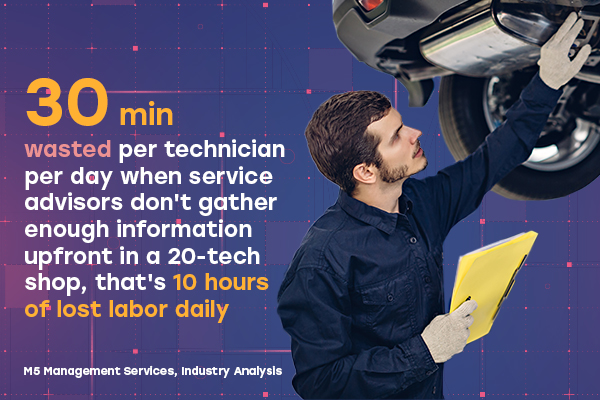
30 minutes wasted per technician per day when service advisors don’t gather enough information upfront. In a 20-tech shop, that’s 10 hours of lost labor daily.
That last point matters more than most shop owners realize. The tech in the bay can only work as fast as the information they have. When they get a repair order without enough detail, they stop. They call the advisor. The advisor calls the customer. The car sits. The clock runs.
What Is the Average Auto Repair Shop Profit Margin?
According to industry benchmarks, the average auto repair shop profit margin typically ranges between 10% and 20% net profit, depending on labor efficiency, parts pricing strategy, technician productivity, and shop overhead.
High-performing shops often achieve:
- 50–65% gross margin on labor
- 20–40% gross margin on parts
- 80–90% technician productivity
- Higher average repair order values through accurate diagnostics
Shops operating below these benchmarks are often losing profit through technician downtime, incomplete diagnostics, underpriced labor, or excessive comebacks.
When Information Isn’t Enough You Need a Profit Platform
Traditional diagnostic tools give you information. They tell you what’s wrong and sometimes how to fix it. That used to be enough.
It is not anymore.
Vehicles today are more complex than they were five years ago. The average repair requires cross-referencing OEM procedures, wiring diagrams, technical service bulletins, and sometimes confirmed fixes from other technicians who have seen the same problem.
When a tech has to hunt across four different sources to find that information, the clock runs. When they can’t find it, they guess and guesses become comebacks.
The benchmark for technician productivity is 90%. In practice, most shops run closer to 70%. That gap is where profit disappears.
Direct-Hit is built to close that gap. Not by giving technicians more data, but by giving them the right data at the right moment so they spend less time searching and more time working.
How Direct-Hit Addresses Each Profitability Driver
- Car count: Faster, more accurate diagnostics reduce comebacks and raise first-time fix rates. Customers who experience a clean repair come back and refer others.
- Labor efficiency: Technicians stop hunting and spend more time working, increasing labor utilization.
- Parts margin: Complete repair procedures ensure all required parts are identified and billed.
From Technician to Business Owner
The hardest part of running a shop is not the technical work. It is the shift in mindset from solving the problem in front of you to building a system that solves problems profitably, consistently, at scale.
That shift requires tools built for both sides of the equation: the repair and the business.
Direct-Hit helps your team fix cars the right way and run your business the right way, so you can charge what the work is worth, capture every dollar on parts, and build sustainable throughput.
Shop owners across the country use Direct-Hit because the tool pays for itself in the first comeback it prevents.
Common Questions About Auto Repair Shop Profitability
What is a good profit margin for an auto repair shop?
A healthy gross profit margin runs between 50% and 65% on labor and 20% to 40% on parts. Net profit typically falls between 10% and 20%.
Why do auto repair shops struggle to make money even when they’re busy?
Being busy and being profitable are not the same thing. Shops lose margin through downtime, underpriced parts, and comebacks.
How does technician efficiency affect profitability?
Technician efficiency determines how many billable hours your shop produces. Lost time directly equals lost revenue.
What is Direct-Hit and how does it help?
Direct-Hit is a diagnostic and repair intelligence platform that provides OEM procedures, wiring diagrams, TSBs, and confirmed fixes in one place.
Is Direct-Hit available across the United States?
Yes. It is used nationwide across all 50 states and accessible on desktop and mobile.
See What Direct-Hit Can Do for Your Shop
If your shop is busy but not as profitable as it should be, the answer is usually in the gap between what your technicians know and how fast they can access it.
The demo takes about 20 minutes.
Share this article:


